Why a Travelling Cinema Packs More Than a Projector
Why a travelling cinema needs more than a projector: plan the film, room, sound and audience cues so the screening feels clear and welcoming.
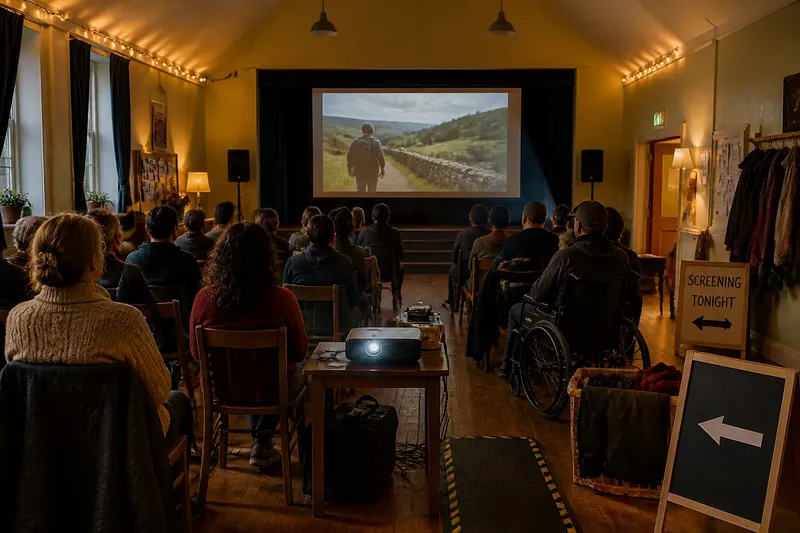
The common mistake with a travelling cinema is treating the projector as the event. The cost is not just a dim picture: people may arrive unsure where to sit, miss the opening, or leave without knowing what happens next. A travelling cinema works when its choices travel together, from the film’s format to the last sign on the door.
These field notes follow that sequence. They are not a packing list for equipment; they focus on how to make a screening understandable and comfortable in a room that may be used for something else tomorrow.
How should you choose a film for a travelling cinema?
Start with the audience you can actually invite, not an imagined crowd. Ask the host what people have requested, what languages are common locally, and whether the event is meant to entertain, prompt conversation or introduce a filmmaker’s work. Those answers narrow the choice more usefully than a broad theme such as “something for everyone”.
Then check whether the film suits the setting. A quiet, visually spare work may be difficult to follow in a draughty room beside a road; a fast comedy can lose its rhythm if the audience is expected to come and go. Consider running time, language, subtitles, sound mix and the emotional register of the film. A title can be suitable for a community without being suitable for every gathering in that community.
Choose the version before you publicise the screening. Confirm that the file or disc is available in a format the playback system can handle, and that the permission or licence covers the planned public event. Keep the supplied file intact rather than relying on a streaming link that may behave differently at the venue. Where rights or technical compatibility are unclear, check with the distributor, rights holder or equipment provider.
Say you are bringing a subtitled documentary to a village institute where the hall’s lights are controlled from the entrance. You could ask the caretaker to identify a dim setting before doors open, then arrange a short viewing check from the back row. The expected observable result is that the subtitles remain legible without leaving the room pitch-black.
What should you learn about the room before arrival?
Ask the host for a plain description of the room’s usual use. A meeting room with tables, a church hall with a central aisle and a school room with fixed desks each ask for a different layout. Request a photograph from the audience’s likely viewpoint if you cannot visit beforehand. It can reveal windows, reflective surfaces, obstructions and the position of the power sockets.
Find out who can open the building, adjust its lights and lock up afterwards. A screening plan that assumes access to a cupboard, a ladder or a control panel can unravel if the person with the key is absent. Agree the arrival window and the latest time the room must be cleared; leave enough space for a calm sound and picture check rather than using every available minute for setup.
Draw a quick room sketch on paper or in a notes app. Mark the screen, projector, audience entrance, accessible route, seats, power source and any area that needs to remain clear. This is not an engineering plan. It is a shared reference that lets the host and travelling team spot conflicts before furniture starts moving.
- Check whether daylight can be reduced without blocking an exit.
- Ask if chairs can be moved and who is responsible for returning them.
- Locate the audience entrance separately from the equipment route where possible.
- Identify a quiet place for late arrivals to wait without crossing the beam.
- Agree where bags, coats and mobility aids can be kept without narrowing a route.
For the screen itself, use a clean, taut surface at a height people can see from the back, while keeping the image clear of doors and windows. A pale wall can work if the host approves and the finish is reasonably even; a portable screen offers a more predictable surface but needs a stable, suitable position. The audience should not have to choose between seeing the film and keeping an entrance clear.
How do sound, light and seating shape the screening?
Sound can be the first thing a room gets wrong. Before the event, listen for a humming fridge, heating system, extractor fan or traffic through a thin wall. Ask the host whether any of it can be turned off for the screening, and decide whether the film’s dialogue can be heard from the rear seats. Do not compensate for a noisy room by turning the volume up without checking who may be affected nearby.
Position speakers so the sound reaches the audience rather than the nearest wall. If the system has left and right speakers, keep them in the intended order and avoid hiding them behind curtains or furniture. A short test with a dialogue scene is more informative than a loud music cue: listen from the front, middle and back, and make a modest adjustment if speech is unclear.
Think about the projector’s light as part of the room, not just the screen image. A beam that crosses a doorway can distract late arrivals, while an exposed cable can become a trip hazard. Route cables away from walkways and secure them using suitable cable covers or a route agreed with the venue. Do not improvise with electrical connections or alter building systems; follow equipment instructions and ask a qualified person when a safe setup is uncertain.
Seating needs to serve more than the ideal view. Leave a clear route to the door and space for people who need an aisle seat or a place for a wheelchair. Avoid creating an unspoken “best” row that is difficult to reach. If the audience can choose their seats, a visible usher or host can help without making anyone explain a personal need in public.
How can people tell what the event is?
A travelling screening often arrives in a building whose regular signs advertise other activities. Give the event a small, consistent visual identity: a clear title on the entrance notice, the same wording on any local announcement, and a person who can greet people. Make the film title, start time, venue entrance and any age guidance easy to spot. If the film is subtitled or has an introduction, say so plainly.
Use signs at decision points rather than covering every wall. One notice outside the building, one at the correct entrance and one pointing towards the room may be enough. If the venue has multiple doors, ask the host which one people normally use after dark. A handwritten arrow can be more useful than a polished poster placed where nobody looks.
Tell people what will happen when they arrive. For example, note whether seating is first come, whether there is a short introduction, and whether the screening begins at the advertised time. If the event includes discussion, describe it as optional rather than implying that everyone must speak. A simple welcome at the door can answer questions that a poster cannot anticipate.
Accessibility information belongs in the invitation, not in a quiet conversation after someone has travelled there. State what you know about step-free access, toilets, seating and subtitle availability; if a detail is uncertain, give a contact who can check it. Avoid promising an arrangement the host has not confirmed.
What should the team check just before doors open?
Keep this final pass short and repeatable. The purpose is to notice an obvious mismatch while there is still time to respond, not to rehearse the entire event. Walk the route an audience member will take, from the outside notice to their seat, and check that each cue makes sense.
- Is the correct entrance marked, and is the room open?
- Can people read the screen and subtitles from the back and sides?
- Can dialogue be heard at a comfortable level across the room?
- Are cables, equipment cases and spare chairs out of the walking route?
- Does the host know who will welcome arrivals and make the start announcement?
- Is the film ready at the intended point, with a backup copy or playback option available if permitted?
- Does someone know how the event will end and when the room must be cleared?
If a problem remains, make the smallest clear adjustment: move a chair, redirect a sign or explain a delay. Do not let an audience sit in uncertainty while the team debates an invisible technical detail. A brief, honest update is easier to follow than silence.
What do travelling cinema organisers often ask?
How do you choose a film for a small rural audience?
Ask the local host what the invitation is for and who is likely to attend, then consider language, subtitles, tone and running time alongside the film’s subject. Choose a specific audience and purpose rather than claiming the title will suit everyone.
Can a travelling cinema use a village hall wall as a screen?
It may be suitable if the host agrees and the surface is clean, pale and even enough for the image to remain clear. Check the picture from different seats before doors open, and use a portable screen if the wall’s finish or room layout makes viewing distracting.
What information belongs on a screening notice?
Include the film title, date and start time, the correct entrance, any relevant age guidance, and clear notes about subtitles or an introduction. Add practical access details and a contact for questions when those arrangements are known.
What should happen if playback fails?
Have a permitted backup playback option ready and agree who will speak to the audience if a pause becomes necessary. If the film cannot be shown, explain the situation plainly and tell people what the host will do next, such as rescheduling or ending the gathering.
What makes the choices hold together?
A travelling cinema is legible when the invitation, room and screening all tell the same story. The film’s format matches the equipment, the room’s layout supports the audience, and the signs describe what people will experience. None of those choices needs to be elaborate; each needs an owner who knows what to check.
Keep a short venue note after each visit: which entrance worked, where the sound was clearest, what the host asked the team to change, and what should be confirmed next time. That record turns local knowledge into a better arrival without treating every hall as interchangeable. The projector travels, but a clear account of the room is what lets the next screening begin with confidence.