Before the Multiplex: The Village Picture Show
The village picture show was never one fixed venue. See how travelling screenings, shared halls and dedicated cinemas offered rural audiences different ways to gather.
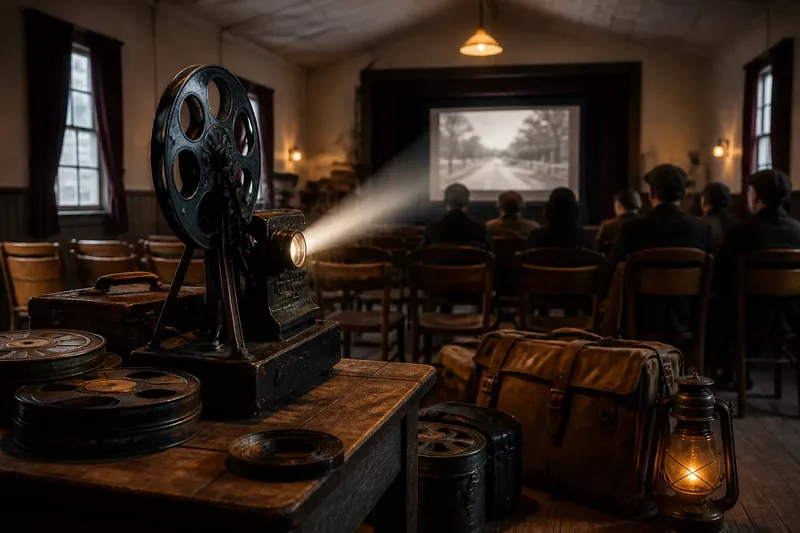
The common mistake in describing the village picture show is to treat it as a small-town cinema transplanted into the countryside. That misses the variety: a screening might arrive with a travelling exhibitor, use a shared hall or take place in a building devoted to films. The village picture show was a way of bringing cinema to a community, not one standard venue.
What did the village picture show look like?
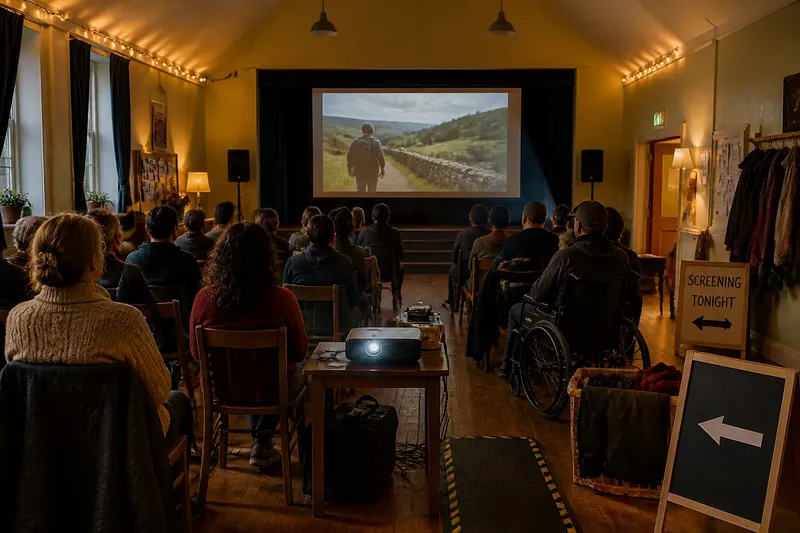
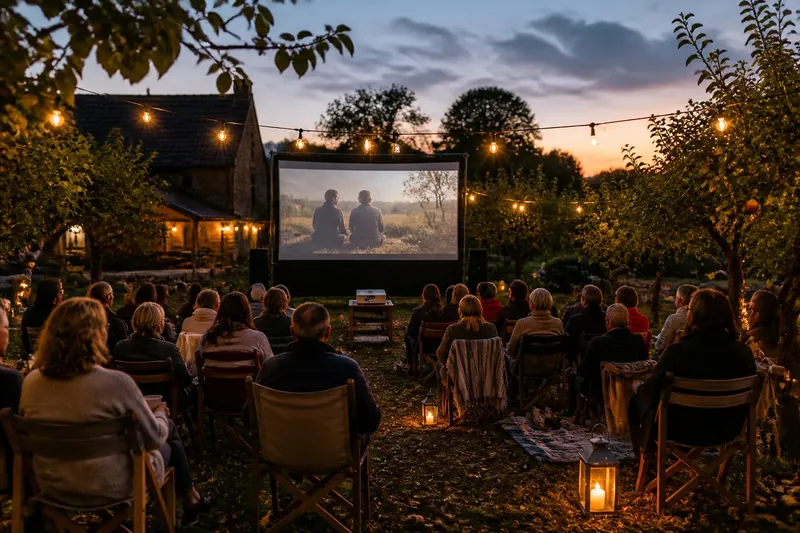
The phrase can describe several arrangements for watching films in a rural community. A travelling exhibitor might bring projection equipment to a schoolroom or public hall. Local organisers might host screenings in a room already used for meetings or performances. In some places, audiences could attend a dedicated cinema.
This is a broad account of possible forms, not a claim that every village followed the same history. The available venue, organisers and local circumstances shaped what residents encountered. A temporary screen could make a familiar room a place for film, while a permanent cinema gave film-going a fixed address.
How did travelling screenings reach villages?
A travelling show depended on a visit. Someone had to arrange a suitable indoor space, publicise the event and prepare for the audience; the exhibitor brought the equipment and programme. The screening could make moving pictures available without a purpose-built cinema, but it was tied to the dates and practical arrangements of that visit.
Imagine a village with a public hall used for meetings. A local organiser books the room and tells residents when a travelling exhibitor will arrive; the exhibitor brings a projector and films, and the hall is arranged for the screening. The expected result is a one-off film evening in a familiar space, with the hall returning to its other uses afterwards.
Why use a shared hall for films?
A hall could host a screening without becoming a cinema. Its established community use made it a possible setting for film, while its mixed purpose meant the room had to be arranged around each event. The screening relied on cooperation between the people responsible for the space and those organising the programme.
That arrangement also connected film-going to local routines. Residents might already know the hall as a place for meetings, dances or performances. Film became one of the activities that could bring people together there, rather than the building’s sole purpose.
What changed when a village had a permanent cinema?
A dedicated cinema offered a fixed venue organised around film exhibition. A shared hall had to accommodate different activities; a travelling show depended on a visit. These distinctions help describe how the arrangements differed, but they do not establish a universal progression from one form to another.
Some communities may have had a permanent cinema, while others relied on shared or visiting arrangements. The forms could also coexist: a dedicated venue in one place did not mean that nearby communities had one, or that other kinds of screening ceased. Local circumstances shaped which options were available and how they were used.
How did each arrangement shape the audience’s evening?
At a travelling screening, the visit itself could make the event feel occasional. In a shared hall, the setting was already part of community life, though it had to be prepared for the film. A dedicated cinema gave audiences a specialised place to attend.
These are differences in setting and organisation, not a ranking of audiences or experiences. In each arrangement, people needed to hear about the screening and choose to attend. Local organisers, venue managers and exhibitors all had a part in making a film event possible.
What do readers ask about the village picture show?
Was every village picture show held in a cinema?
No. The phrase can describe screenings in shared rooms and events brought by travelling exhibitors as well as screenings in dedicated cinemas. The venue depended on local arrangements.
Did travelling screenings stop when a permanent cinema opened?
Not as a general rule that can be applied to every community. Different arrangements could coexist, and a cinema in one place did not mean every nearby settlement had a dedicated venue.
Why might a community use a hall instead of a cinema?
A hall could host films while continuing to serve other local purposes. Whether it was used depended on the spaces and organisers available to the community.
What made a permanent cinema different?
It provided a fixed building devoted to film exhibition, rather than a visiting show or a room shared with other activities. That distinction describes the venue, not a guaranteed change in every local audience’s habits.
How can you read a local cinema story carefully?
Separate what a record says about a venue from what it says about local film-going. A reference to a cinema building does not, by itself, explain whether screenings had taken place elsewhere or whether other forms continued. Look for the people and arrangements in the account: who organised the event, what space hosted it and whether it describes a regular venue or a particular visit.
- Check whether the account names a dedicated cinema; if it does, describe that venue, but do not assume it was the community’s only place for films.
- Check whether it mentions a public hall or schoolroom; if it does, treat the screening as an event in a shared space, but do not call the building a cinema without support.
- Check whether an exhibitor is described as travelling; if so, explain that the screening depended on a visit, but do not infer how often the visit occurred unless the account says.
- Check whether the record gives a date or occasion; if it does, tie your description to that event, but avoid turning one screening into a claim about every year.
- Check whether organisers or venue managers are named; if they are, include their role, but do not assign them other duties that the account does not establish.
- Check whether the account describes other activities in the same building; if it does, call the space shared-use, but do not assume every screening was arranged in the same way.
For example, say you find a local notice naming a public hall and a travelling exhibitor for one evening, but no dedicated cinema. You can state that the notice records a film screening in a shared hall and that the exhibitor was travelling. You cannot infer from that notice alone whether the village never had a cinema, how often screenings took place or whether the hall hosted films in other years.
Why does the village picture show matter?
The village picture show is best understood through access and local organisation, not as a single building type or a fixed ladder of progress. A travelling exhibitor, a hall organiser and a dedicated cinema each represent a different way films could reach rural audiences; which account fits a particular place depends on the evidence available.
When you encounter the phrase village picture show, ask which arrangement the source actually describes. That simple distinction keeps the history grounded: a travelling visit, a screening in a shared hall and a permanent cinema are related forms of rural film-going, but they are not interchangeable.